
Heritage Science Data Service
The Heritage Science Data Service (HSDS) is providing core digital research services as part of the RICHeS programme, the UK’s Research Infrastructure for Conservation and Heritage Science.
Funded by the UK Research and Innovation (UKRI) Arts and Humanities Research Council (AHRC), and developed by the Archaeology Data Service (ADS), HSDS will unlock potential for innovation in heritage science and conservation research and its capacity to understand, preserve, manage and engage with UK heritage.
What is HSDS?
The HSDS is dedicated to providing comprehensive digital research services that empower arts and humanities professionals, heritage and conservation experts and scientists.
It has achieved this through establishing:
- An accredited and FAIR digital repository that preserves and provides access to critical heritage science data, including provision for data from RICHeS collections and facilities investments and RICHeS Access Fund awardees.
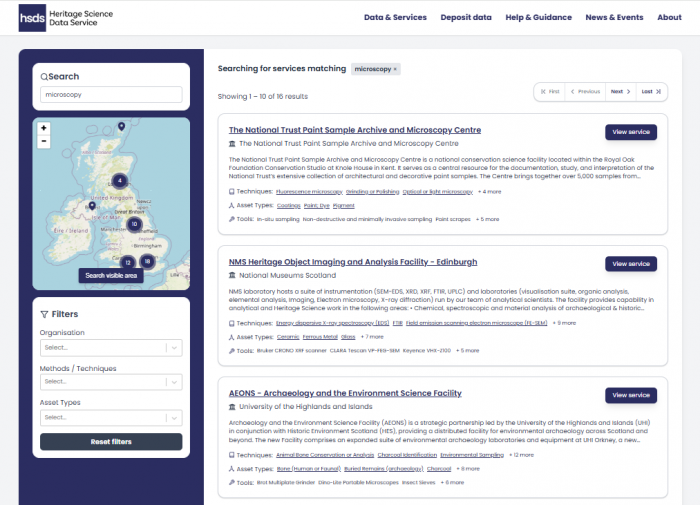
- The HSDS Catalogue of Services; an easy-to-use resource allowing users to discover and access heritage science and conservation collections and facilities that are essential to their research.
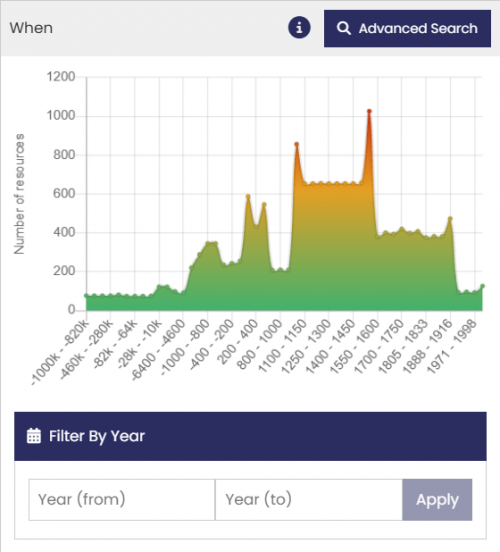
- The HSDS Data Catalogue; a centralised resource to collate heritage science and conservation data collections from across the UK, making datasets findable and accessible for all users.
- A collaboration with STFC Hartree Centre to develop a suite of Virtual Research Environments (VREs) and software tools to allow researchers to access, visualise and analyse large-scale heritage science and conservation datasets.
- The HSDS Small Grants Programme, providing funding to enhance access to heritage science and conservation resources and develop tailored VRE applications and workflows with STFC Hartree.
Overall, the HSDS will foster skills development in digital research methodologies and strategic partnerships with leading heritage institutions and harness cutting-edge technology from the STFC Hartree Centre. HSDS aims to set new standards in research and digital innovation, strengthening its role in advancing heritage science preservation and understanding.
Find out more at the HSDS website.
Learn about our work with HSDS.
HSDS Catalogue of Services
Catalogue of Services and Catalogue of Data
HSDS hosts a range of useful resources for heritage and conservation science research.
The Catalogue of Services is a searchable database of research facilities across the UK. Users can search by location, organisation, methods/techniques (e.g. mass spectrometry, microscopy, remote sensing) and asset types (e.g. bone, stone, paper, soil samples). From there, users can also apply for relevant funding – for example, they can apply to the RICHeS Access Fund to gain access to the British Museum's Multiscale Heritage X-ray Imaging Centre.
Click here to access the Catalogue of Services.
The Data Catalogue is a huge, searchable catalogue of freely available data and metadata records from heritage and conservation science research. Users can search by global location, period, resource type (dating, fieldwork report, scientific analysis), and subject (remains, settlement, marine structures), and filter by data type (structured data, text, CAD).
Click here to access the Data Catalogue.
HSDS regularly run training sessions on how to use its catalogues, which you can find here.
HSDS Data Catalogue
Virtual Research Environments
The Virtual Research Environment (VRE) supports professionals across heritage science, heritage, and related fields by providing a central platform to access specialist software and HSDS datasets remotely. The VRE was built by the STFC Hartree Centre.
The VRE acts as a 'digital workbench', allowing users to access resources that would otherwise need specialist infrastructure or computing power. It is a tool designed to facilitate a wide range of heritage science and conservation research projects, such as calibrating large numbers of radiocarbon dates and automated feature detection of cultural heritage features within LiDAR datasets. VREs are suitable for use by individuals or to facilitate collaborative work between researchers, teams and institutions.
Data access is quicker and easier; users can access HSDS data sets, select relevant files and load data directly into their personal storage area.
Software access includes:
- Blender
- VS Code
- QGIS
- R (GUI interface)
- CloudCompare
- GIMP
- ImageMagick
- MetaShape
Click here to learn more about the Virtual Research Environment.

Ingest
Launched in April 2026, Ingest is the Heritage Science Data Service's digital repository deposit system.
The system is designed to make archiving and sharing heritage science data quicker, easier, and more intuitive.
Improvements include:
- Support for multiple file formats and all deposit sizes.
- Automated metadata extraction using a single template.
- Validation of files and metadata during deposition.
To ensure that the heritage science community could make the most of this resource, HSDS has held regular training sessions at both introductory and intermediate levels. These training sessions will continue to run until December 2026.
Click here to learn more about Ingest.
Small Grants Programme
The application window for the second round of HSDS Small Grants Programme funding closed on 30th September 2026.
The Small Grants Programme covers 100% of full economic costs (FECs) for innovative heritage science research projects across two strands:
- Theme 1: Generate Datasets – Enable or Enhance Access to Heritage Science and Conservation Resources (£500 - £25,000)
- Theme 2: Work with STFC Hartree Centre’s Software Engineering and Technical Teams to Develop Tailored Virtual Research Environment Applications and Workflows (up to £15,000)
This includes, but isn't limited to: conservation science (such as paint sample analysis data), archaeological science (such as LIDAR or osteological data), and environmental science (such as soil samples or climate data).
The programme was open to UK universities, museums, archives, galleries, community partners, and UKRI Independent Research Organisations. Applicants did not need to apply for the full amount.
Round 1 opened in October 2025, with funding announced in March 2026. Read more about previously funded projects here.
Click here to learn more about the Small Grants Programme.
User Needs Research
The National Heritage Science Forum (NHSF) is undertaking a User Needs consultation on behalf of Heritage Science Data Service (HSDS), as part of the RICHeS programme.
The research is designed to test proposed elements of the HSDS during development to gain feedback from a wide range of users. It will explore general requirements for HSDS in terms of functionality and user experience, as well as developmental aspects around high performance computing facilities and Virtual Research Environments. The User Needs Consultation is being conducted by Manda Forster PhD MCIfA and Samantha Paul PhD MCIfA, both highly experienced professionals with expertise in user needs analysis, consultation, and sector surveys.
Read more about the consultants and the project here.
This is a three-year project, lasting from November 2024 to February 2027.
Year 1
The first year (Y1) involved a three-pronged approach to identifying user needs. A set of Discovery 'Design Sprint' workshops, a sector survey, and a series of focussed group discussions helped to establish baseline data on user awareness and priorities (who was using the service and how).
The survey results collected demonstrated a clear consensus on core HSDS functionality priorities:
- Data discovery & research capabilities
- Cross-platform integration
- Training materials & case studies
The results identified distinct preferences between users in different sectors and roles in a complex and lively user ecosystem, which has helped to inform a more nuanced strategy for Y2.
Year 2
Year 2 has been an opportunity to deepen our understanding of how HSDS is actually used across the sector.
In February, NHSF ran focus group sessions aimed specifically at early-career researchers, students, and trainees across the field (including conservation, archaeological science, materials analysis, heritage management, and related disciplines) to understand how HSDS could serve emerging professionals.
Between May - June 2026, NHSF ran another User Needs Survey to track how things are changing and gathering feedback on newly launched services, including the HSDS Catalogue of Services and Data Catalogue. The results are currently being reviewed, and will shape our strategy for Y3.
NHSF Support
As well as consulting on the User Needs Research, the National Heritage Science Forum is also supporting the Heritage Science Data Service with its communications. HSDS is regularly featured on the NHSF social media pages (LinkedIn and Bluesky) and newsletter. We regularly share news, events, training and funding opportunities from HSDS in order to help their services to reach a broader professional audience.
For example, the NHSF blog ran a feature "Introducing the Small Grants Programme", which carried the dual benefits of promoting the scheme to our readers and sharing some excellent case studies from funded projects run by our member organisations.
Click here to read the blog.
Partners
The HSDS is an ambitious initiative developed and managed by the Archaeology Data Service (ADS) in collaboration with the STFC Hartree Centre and key UK heritage institutions.
They include, for input to service design, semantic standards and data provision, Amgueddfa Cymru – Museum Wales, the British Museum, British Geological Survey, Historic England, Historic Environment Scotland, The National Archives, The National Gallery, and Natural History Museum.
For user needs definition, service data collection and technical implementation, HSDS are partnered with National Heritage Science Forum, Manchester Metropolitan University, Flax & Teal and Kartography.